
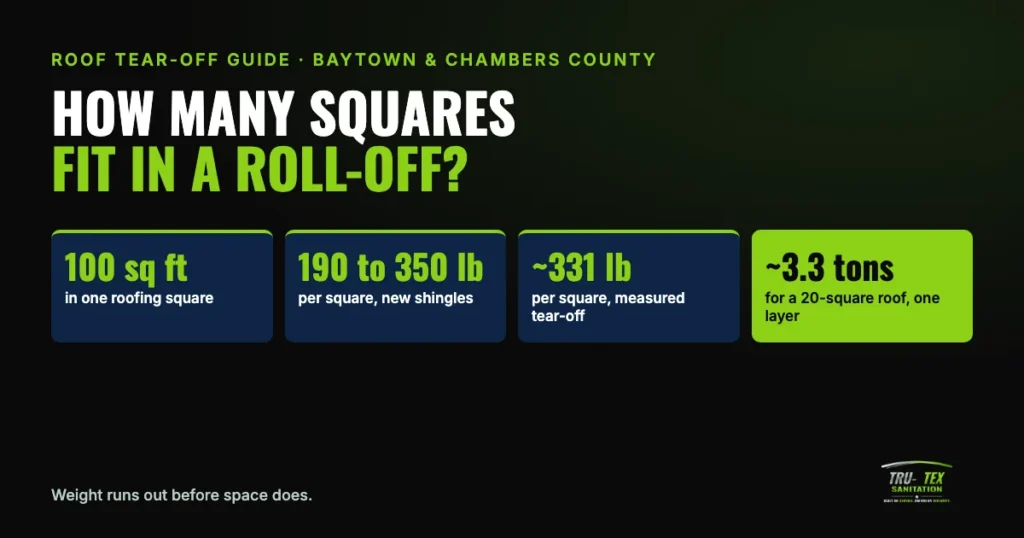
By space, most roll-offs hold more squares than a typical house has. By weight, they don’t. New asphalt shingles weigh about 190 to 350 pounds per square, and a torn-off roof runs heavier: a survey EPA cites measured 4,640 pounds of debris from a 1,400 square foot roof replacement. For a tear-off, the tonnage your quote includes matters more than the yards.
The Short Version
- A square is 100 square feet of roof.
- New asphalt shingles weigh about 190 to 350 lb per square, depending on the style.
- A measured tear-off in EPA’s data came to 3.31 lb per square foot, or about 331 lb per square.
- By our math, a 20-square roof is roughly 3.3 tons of debris but only about 9 cubic yards of space.
- Two layers double the weight. The residential code won’t let a third layer go over two.
- In Baytown, shingle-only replacement needs no building permit, but decking work does.
- Chambers County is a TDI first-tier county, so a new roof there needs a windstorm inspection to qualify for TWIA coverage.
Roofers and homeowners ask the same question before a tear-off: how many squares will fit in the dumpster? The honest answer is that space is rarely the problem. Shingles are dense, and a roll-off usually hits its weight allowance long before the debris reaches the top. This guide works through the numbers using manufacturer data sheets and EPA figures, then covers the local rules that come with a new roof around Baytown and Chambers County. For the full rental process, start with how roll-off dumpster rental works in Baytown.
Planning a tear-off?
Tell us the number of squares, the layers and the address, and we will match the box and quote it straight.
Call (936) 548-9300.
Get a Roll-Off QuoteWhat Is a Square, and How Much Does One Weigh?
A square is 100 square feet of roof. Shingle makers sell and spec their products by the square. CertainTeed’s data sheets, for example, list “Weight/Square” with the footnote “Weight per 100 square feet.” EPA’s national estimate of roof replacement waste assumes an average house roof of 1,400 square feet, or 14 squares.
Weight depends on the shingle. Here is what CertainTeed publishes for four of its asphalt lines:
- XT 25, a basic 3-tab shingle: “Weight/Square (approx.): 190-203,” per its product data sheet
- Landmark, a standard architectural shingle: “211 to 225 lb,” per its technical data sheet
- Landmark PRO, a heavier architectural shingle: “231 to 240 lb,” per its product data sheet
- Presidential Shake, a designer shingle: “350 lb,” per its product data sheet
Those are new shingles. What comes off a roof weighs more, because it brings nails, underlayment, flashing and sometimes trapped moisture with it. The best measured figure we found is in the U.S. Environmental Protection Agency’s 2009 report Estimating 2003 Building-Related Construction and Demolition Materials Amounts. It lists a 1997 National Association of Home Builders survey of a Maryland single-family remodel with a new roof: 1,400 square feet, 4,640 pounds of debris, or 3.31 pounds per square foot. That works out to about 331 pounds per square.
For more on how debris weight drives every dumpster quote, see how much renovation debris weighs.
Why Does Weight Run Out Before Space?
Because shingles pack a lot of weight into a small volume. EPA’s Volume-to-Weight Conversion Factors (April 2016) puts “Composition Roofing” at 731 pounds per cubic yard. Mixed (composite) construction and demolition debris comes in at 417 pounds, and clean dimensional lumber at 169.
Put EPA’s two figures together and you can estimate a whole roof. This is our math, not a published number, and loosely thrown debris takes more room than a density figure suggests, so treat the volumes as a floor:
- 15 squares, one layer: about 4,965 lb (2.5 tons) in roughly 7 cubic yards
- 20 squares, one layer: about 6,620 lb (3.3 tons) in roughly 9 cubic yards
- 30 squares, one layer: about 9,930 lb (5 tons) in roughly 14 cubic yards
- 20 squares, two layers: about 13,240 lb (6.6 tons) in roughly 18 cubic yards
Look at the 20-square roof. It fills less than half of a 20-yard box by volume, but it is over three tons of material. That is why the right question for a tear-off is how much weight your quote includes, not how many yards the box holds.
Which Size Box Should You Get for a Roof?
Size for the weight, then check the space. By our estimate, a single-layer roof on a typical house fits comfortably in a mid-size box by volume, so the deciding factor is the tonnage that comes with the rental. A second layer, wet shingles, or plywood decking all push the weight up fast.
When you call, have these ready:
- The number of squares, from your roofer’s measurement or estimate
- How many layers are coming off
- The shingle type, if you know it (3-tab, architectural or designer)
- If any decking is being replaced
- Where the box can sit, ideally close to the roof edge you will throw from
We quote by size and job, with no surprise fees, so those details are what get you an accurate number. Our roll-off size guide compares every box, and the 20-yard page shows the dimensions. For how weight and other factors shape the price, see what drives the cost of a dumpster in Baytown.
Not sure how heavy your roof will be?
Give us the squares and layers and we will do the math with you before the box shows up.
Call (936) 548-9300.
Get a Roll-Off QuoteHow Many Layers Are Coming Off?
It matters more than most people expect, because every layer adds its full weight again. The residential building code also limits how many layers a roof can carry. Section R908.3.1.1 of the 2015 International Residential Code says a roof re-cover “shall not be permitted” in three cases, including “where the existing roof has two or more applications of any type of roof covering.” The same section rules out a re-cover when the existing roof is water soaked or too deteriorated to serve as a base.
That is the edition Baytown uses. The city’s building codes page lists the 2015 International Residential Code for permits issued after November 1, 2020. So if your house already has two layers, both come off, and the dumpster has to handle double the weight.
Do You Need a Permit or an Inspection for a New Roof?
It depends on where the house is and how much of the roof is being replaced.
In Baytown, the city’s residential permit guide lists “Roof shingle replacement only” under projects that do not need a building permit. “Roof deck installation, replacement, or repair” does need one. The guide notes it is “NOT a complete list,” so call the city’s Building Services if your job is unusual.
In Chambers County, a new roof also has to clear the Texas Department of Insurance windstorm program if you want coverage through the Texas Windstorm Insurance Association. TDI’s windstorm questions page lists Chambers among the first-tier coastal counties and says work “including re-roofs or roof repairs” in those areas must be built and inspected to TDI’s specifications to qualify for TWIA coverage. TDI’s consumer guide says “Most new construction, roof replacements, major repairs, and other alterations require an inspection and certificate of compliance.” One exception it lists is “Roof repairs of less than 100 square feet that don’t involve decking.”
For Harris County, TDI’s list covers only certain cities east of State Highway 146: La Porte, Morgan’s Point, Pasadena, Seabrook and Shoreacres. Baytown is not on that list. Because Baytown sits in both Harris and Chambers counties, homeowners in the Chambers County side of the city should confirm with TDI before the roof goes on.
If you hire a roofer, ask who is pulling any permit and scheduling the inspection. The dumpster just needs to be there on tear-off day.
What If the Old Roof Might Contain Asbestos?
Check before it comes off. EPA’s asbestos overview lists “Roofing and siding shingles” among the places asbestos may be found.
The federal and state notice rules mostly skip single-family homes. The Texas Department of State Health Services asbestos FAQ says “One private residence is not subject to the asbestos NESHAP regulations and notification is not required.” Disposal is a different matter. The Texas Commission on Environmental Quality’s debris guide, RG-518, sends asbestos-containing shingles to a Type I landfill “with Special Waste Authorization,” not to an ordinary construction debris landfill.
If you suspect asbestos, have the shingles tested and tell us before the box is delivered. Suspect material should not go in a standard roll-off. See our list of things you cannot put in a dumpster for the rest.
How Do You Load a Roof Tear-Off Safely?
Set the box as close to the drip line as the truck can safely reach, so crews can drop debris straight in instead of carrying it across the yard. Tarping the ground between the house and the box catches stray nails.
On taller buildings, federal rules come into play. OSHA’s construction standard 29 CFR 1926.252 says “Whenever materials are dropped more than 20 feet to any point lying outside the exterior walls of the building, an enclosed chute of wood, or equivalent material, shall be used.” It also requires that waste material “be removed from the immediate work area as the work progresses,” which is easier with the box right next to the house.
Keep the load level with the top of the box and spread the weight across the floor instead of piling it at one end.
Where Do Old Shingles Go?
Most go to a landfill. TCEQ’s RG-518 lists “roof shingles and other roofing material” as construction and demolition waste. For shingles without asbestos, it names a cement kiln fuel source as the preferred option, with Type IV and Type I landfills as disposal routes.
Recycling is growing but still small. EPA’s 2018 fact sheet on materials management counts 15.1 million tons of asphalt shingles generated from construction and demolition that year, with 13.0 million tons landfilled and 2.1 million tons going to a next use. In Texas, the Department of Transportation’s asphalt shingles page says its special provisions “allow contractors to add up to five percent RAS,” or recycled asphalt shingles, to asphalt pavement.
Common Questions About Roof Tear-Off Dumpsters
Short answers to what homeowners and roofers ask before a tear-off.
How many squares of shingles fit in a 20-yard dumpster?
More than most house roofs have, by space. By weight, far fewer. Using EPA figures, a 20-square, single-layer tear-off comes to about 3.3 tons of debris in roughly 9 cubic yards. Ask how much weight your quote includes before you book.
How much does a square of shingles weigh?
New asphalt shingles weigh about 190 to 350 pounds per square, based on CertainTeed’s data sheets for 3-tab, architectural and designer lines. A torn-off roof weighs more because of nails and underlayment. A measured tear-off in EPA’s data came to about 331 pounds per square.
Do I need a permit to replace my roof in Baytown?
Not for shingles alone. Baytown’s residential permit guide lists “Roof shingle replacement only” as not needing a building permit, but roof deck installation, replacement or repair does. The city notes the list is not complete, so check with Building Services for unusual jobs.
Do I need a windstorm inspection for a new roof in Chambers County?
If you want coverage through the Texas Windstorm Insurance Association, generally yes. Chambers is a TDI first-tier county, and TDI says most roof replacements require an inspection and certificate of compliance. Repairs under 100 square feet that don’t involve decking are an exception.
Can old shingles go in a roll-off if they might contain asbestos?
No. EPA lists roofing shingles as a place asbestos may be found, and TCEQ sends asbestos-containing shingles to a Type I landfill with special authorization. Have suspect shingles tested and tell us before delivery.
Are old shingles recycled in Texas?
Some are. TxDOT allows up to five percent recycled asphalt shingles in asphalt pavement under its special provisions. Nationally, though, EPA’s 2018 figures show most shingles, 13.0 of 15.1 million tons, still went to landfills.
Ready for tear-off day?
Tell us the squares, layers and address, and we will match the box and quote it by size and job, with no surprise fees. Serving Baytown and the Chambers and Liberty County area.
Call (936) 548-9300.
Get a Roll-Off Quote