
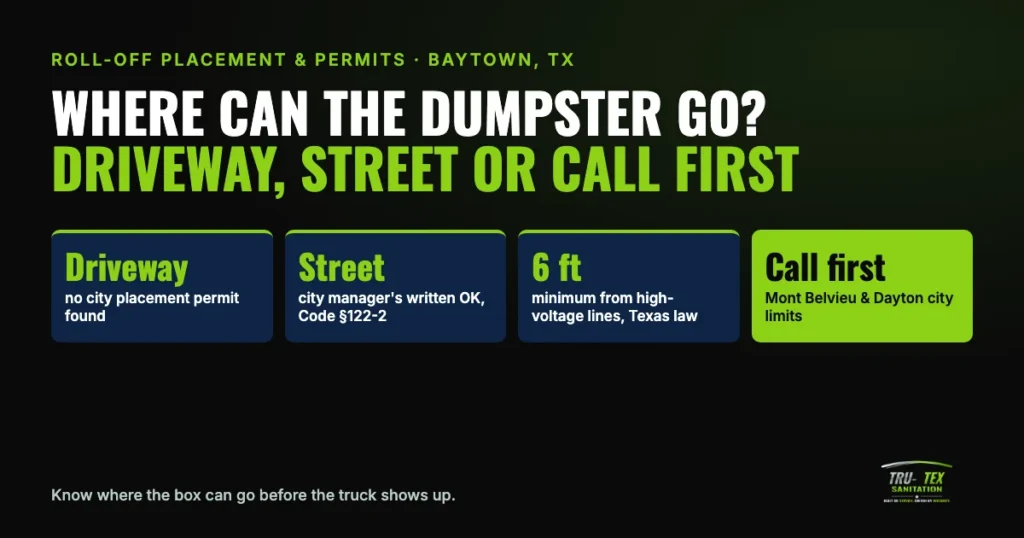
Put it on your own property, usually the driveway. Baytown’s code makes it unlawful to block streets, sidewalks and alleys with property, and storing anything there takes written permission from the city manager. We found no city permit for a roll-off on your own driveway. Give the truck a straight path in, and keep the box well away from power lines.
The Short Version
- Driveway or private lot first. The street is the exception, not the default.
- Baytown Code §122-2: storing property on a street or sidewalk needs the city manager’s written OK.
- A commercial waste container on the right-of-way is an offense under §86-136, and the city can remove it at the owner’s cost.
- The truck needs a straight approach and open air overhead, not just room for the box.
- Texas law keeps work and equipment at least 6 feet from high-voltage lines.
- After a declared disaster, Baytown allows one waste container per damaged home, with time limits.
- Inside Mont Belvieu or Dayton city limits, the city controls roll-off service. Call city hall first.
Baytown is not a one-rule town. Its street rule dates back to a 1965 ordinance, and neighboring cities a few miles away run roll-off service in a completely different way. Most “do I need a permit” pages online give a national rule of thumb.
This one quotes the Baytown code and names the city offices to call. It also covers what the truck needs to see before a roll-off dumpster in Baytown gets backed onto your driveway.
Not sure your driveway will work?
Tell us what is parked there, what hangs overhead, and how the truck gets in. We will tell you before delivery day if the spot works.
Call (936) 548-9300.
Get a Roll-Off QuoteDo You Need a Permit for a Dumpster in Your Baytown Driveway?
For placement on your own driveway or lot, we did not find one. We read the Baytown Code of Ordinances, current through June 2026, and found no permit for a homeowner to set a roll-off on private property.
We also found no lighting or reflector rule and no time limit for a roll-off on private property, outside the disaster rule covered below. For a long project, a quick call to the city is still worth it.
Hours are covered. Baytown’s noise rules list “the delivery, pickup, or raising of any dumpster, in or near residential areas” between 7:00 a.m. and 9:00 p.m. as an exception, under Baytown Code §34-366(11). Plan drop-offs and pickups inside that window.
A city permit is not the only rule that can apply, though. Your subdivision may have its own, which the next sections cover.
Can a Roll-Off Dumpster Go in the Street in Baytown?
Not without the city’s written OK. The street is public right-of-way, and Baytown’s code treats it that way.
Baytown Code §122-2 makes it unlawful to “encumber or obstruct the sidewalks, streets, alleys and other public rights-of-way” with property of any kind. Using them to store goods takes “permission from the city manager, in writing, before any such use is made.” A denial can be appealed to city council.
The same section allows “temporary use” of the street by people “receiving, shipping and handling” property. A box that sits at the curb for a week looks like storage, not handling. Ask first.
There is a second rule for waste containers. Under Baytown Code §86-136, as amended in January 2026, placing a commercial solid waste container on a public right-of-way is an offense. Section 86-139 lets the city remove a container left there after notice, at the owner’s expense.
Fines are possible too. Baytown’s general penalty section, §1-14, says “each day an offense shall continue shall constitute a separate offense.” Sidewalks count the same as the street.
Who to call in Baytown: the City Manager’s Office at 2401 Market Street, 281-420-6500, is the office §122-2 names. For general trash questions, the city’s garbage and recycling page lists Public Works and Engineering at 281-420-5300.
We did not find a street dumpster permit form, fee, or online application on the city’s website, so ask the office what it needs in writing. Once you know the box stays on your property, the next question is your neighborhood’s own rules.
Want us to look at the spot first?
Send a photo of the driveway and the street out front, and we will tell you where the box fits and what needs to move.
Call (936) 548-9300.
Request a Roll-Off QuoteDo HOA or Deed Restrictions Apply to a Dumpster?
They can, and they are separate from city code. Many subdivisions have deed restrictions or HOA rules that cover containers, where they sit, and how long they stay.
Read your restrictions before you book. If they call for approval, get it in writing and keep it handy on delivery day. A quick email to the HOA manager now beats a violation letter halfway through a remodel.
Then look at the driveway itself, because the truck needs more room than most people expect.
How Much Room Does a Roll-Off Truck Need?
More than the box. Our 20, 30 and 40-yard roll-offs share about the same footprint, roughly 22 feet long and 8 feet wide, by the approximate dimensions on our 20-yard dumpster page. The walls are about 4.5, 6 and 8 feet tall.
The truck backs in straight, then tilts its bed to slide the box off the back. That means it wants a straight approach, the width of the box, and open air above the bed while it tilts.
A quick checklist before delivery:
- Move the cars and open any gate the truck has to pass.
- Check overhead. Low branches, basketball goals and carport roofs get in the way of the tilting bed.
- Clear the path. Mailboxes, sprinkler heads and garden edging along the drive are easy to clip.
- Pick the end of the drive that leaves you room to walk and load.
Need help picking the box itself? Our guide to which roll-off size fits your project matches each box to real jobs. The bed that tilts to unload also leads to the most important clearance of all.
How Far Should a Dumpster Be From Power Lines?
Keep the box, the truck and the raised bed well away from overhead lines. This one is set by state and federal law, not by preference.
Under Texas Health and Safety Code Chapter 752, no one may do work where a person, tool, equipment or material could come “within six feet of a high voltage overhead line.” High voltage means “more than 600 volts.” Work closer than that takes notice to the line operator “at least 48 hours before the work begins” and an agreed safety arrangement.
Federal workplace rules ask even more of the truck. The OSHA standard 29 CFR 1910.333 says any vehicle “capable of having parts of its structure elevated near energized overhead lines” must keep 10 feet of clearance, and more above 50 kV.
What that means for you: look up before you pick the spot. Keep the box away from the service drop to the house and from street lines, and tell us when you call if lines cross the driveway. Clear air overhead is half the job; solid ground underneath is the other half.
How Do You Protect Your Driveway and Yard?
Pick a flat, firm spot. A level surface keeps the box from shifting as it fills and makes pickup safer.
Concrete is the best choice. A loaded box on grass can rut a yard, and Gulf Coast yards soak up rain fast. If rain is in the forecast, talk with us about the spot before the storm, not after.
Weight matters here. Concrete, dirt and roofing are much heavier than they look, so a full box presses hard on whatever is underneath. Our guide to how much renovation debris weighs shows how fast heavy loads add up.
Running a business with a permanent dumpster pad instead? See our tips on keeping a commercial dumpster area code-compliant. Storms change more than the ground, and Baytown has a rule for that too.
What Changes After a Hurricane or Flood in Baytown?
After a declared disaster, Baytown lets a damaged home keep a waste container on the property during repairs, with limits.
Under Baytown Code §22-126.5, adopted in 2017, waste and storage containers may stay on a single-family property damaged by a disaster only during rehabilitation or reconstruction. Without a building permit, the limit is six months after the disaster declaration.
With a building permit, the container can stay until the certificate of occupancy is issued, or one year passes, whichever comes first. The code also says: “No more than one waste container and one storage container can occupy each residential property at a time.”
The rule only covers structures that were damaged in the disaster and occupied at the time, under §22-120. Outside Baytown, the bigger question is often who can bring the box at all.
Do the Same Rules Apply in Mont Belvieu, Dayton or on County Roads?
No. City limits change everything, so check with the city first.
Mont Belvieu: Mont Belvieu Code §14-177(c) makes the city’s solid waste department the exclusive provider of collection inside city limits, and it applies to “twenty to forty-yard roll off boxes.” The city’s roll-off dumpsters page says the same and lists Public Works at 281-576-6147.
Section 14-187 also says containers owned by private refuse collectors “shall not be placed on any street or right-of-way within the city.”
Dayton: under Dayton Code §11.605, only the city or its franchised hauler may collect solid waste in the city. It is also unlawful for a property owner to pay anyone else to do it. Call Dayton city hall before you book.
County roads: we found no published county rule for dumpsters on county road right-of-way. Keep boxes off the road and out of the ditch. In unincorporated Chambers County, the county permitting office takes questions at 409-267-2700.
A mailing address and city limits are not the same thing, so check which one applies to your property. For the full rental process from first call to pickup, see how roll-off rental works in Baytown.
Common Questions About Dumpster Placement and Permits in Baytown
These are the questions people ask before a box rolls up their driveway. Each answer points back to the rule it rests on.
Do I need a permit to put a dumpster in my driveway in Baytown?
We did not find one. Baytown’s code, current through June 2026, has no permit for setting a roll-off on your own driveway or lot. Your HOA or deed restrictions may still have rules about containers, so check those. For a long project, a quick call to the city costs nothing.
Can I put a roll-off dumpster in the street in front of my house?
Only with the city’s written OK. Baytown Code §122-2 makes it unlawful to obstruct streets and sidewalks, and storing property there takes written permission from the city manager. A waste container left on the right-of-way after notice can be removed at the owner’s expense. Call the City Manager’s Office at 281-420-6500.
How close can a dumpster be to power lines?
Texas law keeps people, equipment and materials at least 6 feet from high-voltage lines, meaning lines over 600 volts. Federal OSHA rules ask more of the truck: 10 feet of clearance for any vehicle with a part that rises near energized lines. Pick a spot away from the service drop and street lines.
What hours can a dumpster be dropped off in Baytown?
Baytown’s noise code lists the delivery, pickup or raising of a dumpster in or near residential areas between 7:00 a.m. and 9:00 p.m. as an exception to its noise rules. That is the window to plan around. Tell us when you need the box, and we will set the delivery time with you.
How long can a dumpster stay at my house after a hurricane?
Under Baytown Code §22-126.5, six months after the disaster declaration if you have no building permit. With a permit, until the certificate of occupancy or one year, whichever comes first. The limit is one waste container and one storage container per home, and the rule only covers homes damaged and occupied at the time.
Do the same rules apply in Mont Belvieu or Dayton?
No. Inside Mont Belvieu city limits, the city is the exclusive provider of roll-off service, and private containers may not sit on any street. Inside Dayton, only the city or its franchised hauler may collect. A mailing address is not the same as city limits, so call city hall first.
Ready to set the box in the right spot?
Tell us the address, the debris and where you want the box. We will check the spot with you, recommend the size, and quote it with no surprise fees. See every roll-off dumpster we rent.
Call (936) 548-9300.
Get a Roll-Off Quote