

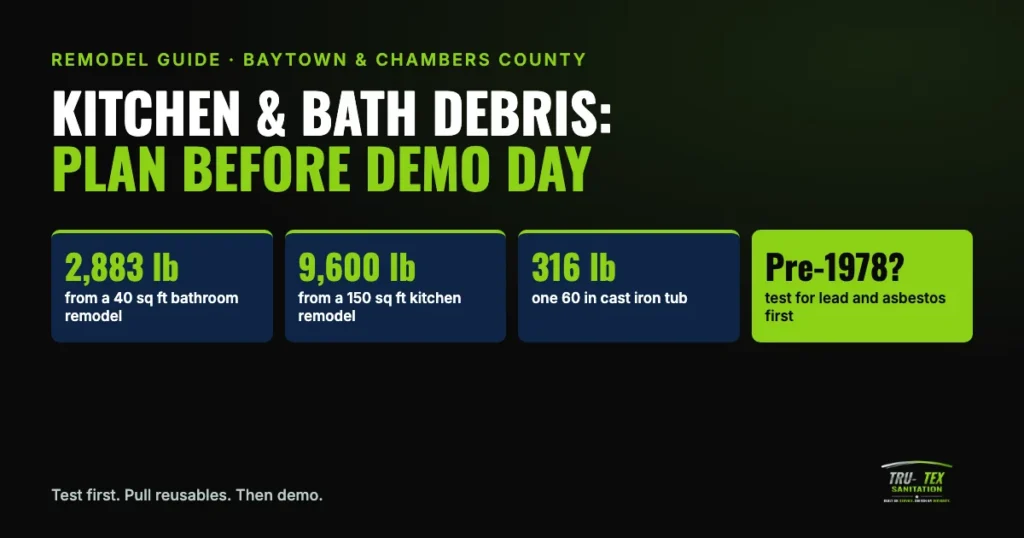
Plan for weight and for three checks. In job-site surveys, a 40 square foot bathroom remodel produced 2,883 pounds of debris and a 150 square foot kitchen remodel produced 9,600. Before demo, find out if the home was built before 1978 (lead paint), if old vinyl flooring or ceiling texture could contain asbestos, and how the old refrigerator will be handled. Pull anything reusable out first.
The Short Version
- Small rooms make big piles: 2,883 lb from a 40 sq ft bath and 9,600 lb from a 150 sq ft kitchen in EPA’s survey data.
- A cast iron tub alone can weigh 316 lb, and 3 cm granite runs about 18 to 19 lb per square foot.
- Homes built before 1978: paid contractors who disturb paint must be EPA-certified.
- Old vinyl floor tiles, sheet flooring backing, adhesives and ceiling texture can contain asbestos. Test before you tear.
- Refrigerators and freezers have federal refrigerant disposal rules, so keep them out of the box.
- In Baytown, swapping cabinets, counters or fixtures needs no permit, but remodeling, sheetrock and demolition do.
Kitchens and bathrooms pack a lot of heavy material into a small space. Tile, cast iron, stone and plaster are heavy, and older homes can hide materials that should never go in a dumpster. A little planning before the first swing saves a second box, a surprise weight charge and a lot of cleanup. This guide covers what comes out of these rooms, what to check first and what the Baytown and Texas rules say. For the rental basics, start with how roll-off dumpster rental works in Baytown.
Demo day on the calendar?
Tell us the rooms, the flooring and anything heavy coming out, and we will match the box and quote it straight.
Call (936) 548-9300.
Get a Roll-Off QuoteHow Much Debris Does a Kitchen or Bathroom Remodel Make?
More than the size of the room suggests. The U.S. Environmental Protection Agency’s 2009 report Estimating 2003 Building-Related Construction and Demolition Materials Amounts summarizes job-site surveys of real remodels:
- A 1997 National Association of Home Builders survey of a bathroom remodel in Chapel Hill, North Carolina: 40 square feet, 2,883 pounds of debris
- A kitchen remodel in Portland, Oregon, surveyed by Metro in 1993: 150 square feet, 9,600 pounds
- A 1997 NAHB survey in Maryland of a kitchen remodel with a room addition: 560 square feet, 10,713 pounds
By our math, that small kitchen came to about 4.8 tons and the bathroom to about 1.4 tons. EPA notes that renovating kitchens, bathrooms and entire houses “typically generates more waste per square foot than new construction, largely because of the demolition that accompanies remodeling.”
Which Items Weigh the Most?
A few pieces carry most of the weight. The heaviest is usually stone or a cast iron tub:
- A 60-inch cast iron alcove tub: Kohler’s spec sheet for its Villager bath lists “316 lbs (143.3 kg)”
- Granite countertops: MSI says “Granite 3cm weighs about 18-19 pounds per square foot”, so 40 square feet of counter is roughly 720 to 760 pounds by our math
- Appliances: EPA’s Volume-to-Weight Conversion Factors (April 2016) use 250 pounds for a refrigerator, 150 for a stove and 125 for a dishwasher
- Drywall: the same EPA table puts demolition gypsum at 467 pounds per cubic yard
For more on how debris weight shapes a dumpster quote, see how much renovation debris weighs.
Was the House Built Before 1978?
If so, plan for lead paint. EPA’s Renovation, Repair and Painting program says “Approximately three-quarters of the homes in the United States built before 1978 still contain some lead-based paint.”
If you hire a contractor, they need certification. EPA’s page for contractors says “In general, anyone who is paid to perform work that disturbs paint in housing and child-occupied facilities built before 1978 must be certified.” The rule’s small-job exemption does not cover a gut. Under 40 CFR 745.83, minor repair work only qualifies “where the work does not involve window replacement or demolition of painted surface areas.”
If you do the work yourself in your own home, EPA’s guidance for do-it-yourselfers says the rule generally “does not apply to homeowners doing RRP projects in their own home,” with exceptions for rentals, home child care and house flippers. It still recommends that you “Use heavy plastic sheeting or bags to collect your waste and seal everything securely with duct tape.” EPA says most of that waste “is classified as solid, non-hazardous waste” and should go to a licensed solid waste landfill, but to check local and state rules first.
Could the Old Flooring or Ceiling Contain Asbestos?
It could, in an older home. EPA’s asbestos overview lists “Vinyl floor tiles and the backing on vinyl sheet flooring and adhesives” and “Textured paint and patching compounds used on walls and ceilings” among the places asbestos may be found. Those are exactly the layers a kitchen or bath gut tears into.
EPA’s advice for homeowners lists “You are planning to remodel your home” as a reason to get an inspection, and says “A trained and accredited asbestos professional should take samples for analysis.” If testing finds asbestos, that material needs professional removal and does not go in a standard roll-off. Our list of things you cannot put in a dumpster covers the rest.
What Should You Do With the Old Refrigerator?
Keep it out of the box unless the refrigerant has been properly recovered. EPA’s safe disposal rules say household refrigerators and freezers, and window unit air conditioners, “are subject to special safe disposal requirements.” It adds that “The final person in the disposal chain (such as a scrap metal recycler or landfill owner) is responsible for ensuring that refrigerant is recovered from equipment before its final disposal.” Texas landfill rules at 30 TAC 330.15(e) point back to those same federal requirements.
Stoves and dishwashers carry no refrigerant, but they are heavy. Count them in your weight estimate or set them aside for scrap or donation.
Want help sizing the box?
Tell us what is coming out, including the tub, the counters and the flooring, and we will size it by weight, not guesswork.
Call (936) 548-9300.
Get a Roll-Off QuoteWhat Should You Pull Out Before Demo Starts?
Anything someone else can use. EPA’s page on managing construction and demolition materials points to “Easy-to-remove items like doors, hardware, appliances, and fixtures. These can be salvaged for donation or use during the rebuild or on other jobs.” Every item that leaves in one piece is weight that stays out of the dumpster.
Habitat for Humanity ReStores take many of these items, but Habitat notes that ReStores “are independently owned,” so each sets its own rules. Houston Habitat’s ReStore donation page, for example, says “Appliances must not be older than 10 years, must be functional, and must not be gas appliances,” takes cabinets only as “complete units with all doors and drawers,” and says “we do not pick up granite countertops.” Call ahead before you haul anything over.
A simple order for demo day:
- Test first, if the home is older, for lead and asbestos
- Pull reusable cabinets, fixtures and appliances
- Set aside the refrigerator for proper disposal
- Remove counters and cabinets, then fixtures and the tub
- Take out tile, drywall and flooring last
Do You Need a Permit in Baytown?
It depends on the scope. Baytown’s residential permit guide lists these interior projects as not needing a building permit: “Replacement of plumbing fixtures,” “Replacement of cabinets & counter tops” and “Floor covering (carpet, linoleum, tile).”
These do need one: “Remodeling,” “Sheetrock,” “Demolition,” “Water heater installation or replacement,” and plumbing or electrical work “other than exchange of fixtures.” So swapping a vanity and a toilet is one thing, but gutting the room to the studs is another. The guide notes it is “NOT a complete list,” so check with the city’s Building Services when in doubt. These are city rules. Outside Baytown city limits, check with your county.
Which Box Should You Get, and Where Should It Go?
Size by weight first. A bathroom gut often fits a smaller box by volume, but a cast iron tub and a tile floor add up. A kitchen can reach several tons, as the survey numbers above show. Our roll-off size guide compares every box, and the 20-yard page shows the dimensions.
When you call, tell us:
- Which rooms and roughly how many square feet
- The heavy items: stone counters, a cast iron tub, tile, plaster
- If the house was built before 1978 or has old vinyl flooring
- Where the box can sit, close to the door you will carry debris through
We quote by size and job, with no surprise fees. For what moves the price, see what drives the cost of a dumpster in Baytown.
Common Questions About Kitchen and Bathroom Remodel Debris
Short answers to what homeowners and remodelers ask before demo day.
How much debris does a bathroom remodel make?
More than you would think for the size. In a job-site survey cited by EPA, a 40 square foot bathroom remodel produced 2,883 pounds of debris, or about 1.4 tons. A cast iron tub alone can weigh over 300 pounds.
How much debris does a kitchen remodel make?
In one survey cited by EPA, a 150 square foot kitchen remodel produced 9,600 pounds, about 4.8 tons. Stone countertops, tile and plaster all add weight fast.
Do I need to test for lead paint before remodeling?
If the home was built before 1978, plan for it. EPA says about three-quarters of U.S. homes built before 1978 still contain some lead-based paint, and paid contractors who disturb paint in those homes must generally be EPA-certified.
Can old vinyl flooring go in a dumpster?
Only if it is not asbestos-containing. EPA lists vinyl floor tiles, the backing on vinyl sheet flooring and adhesives as places asbestos may be found. In an older home, have it tested before removal.
Can I throw my old refrigerator in the roll-off?
No, not with refrigerant still in it. EPA puts household refrigerators and freezers under special safe disposal requirements, and Texas landfill rules follow them. Have the refrigerant recovered or take it to a recycler that handles it.
Do I need a permit to remodel a kitchen or bathroom in Baytown?
For a true remodel, yes. Baytown’s guide lists remodeling, sheetrock and demolition as needing a permit. Replacing cabinets, counters, plumbing fixtures or floor covering alone does not.
Ready for demo day?
Tell us the rooms and the heavy items, and we will match the box and quote it by size and job, with no surprise fees. Serving Baytown and the Chambers and Liberty County area.
Call (936) 548-9300.
Get a Roll-Off Quote